How to Use Ramadan 2026 to Find a Nikah Partner: A Practical Plan for Educated Muslims
How to use Ramadan 2026 to find a nikah partner: a practical plan for educated Muslims, with dua, family etiquette, iftar circles, and a 30-day timeline.
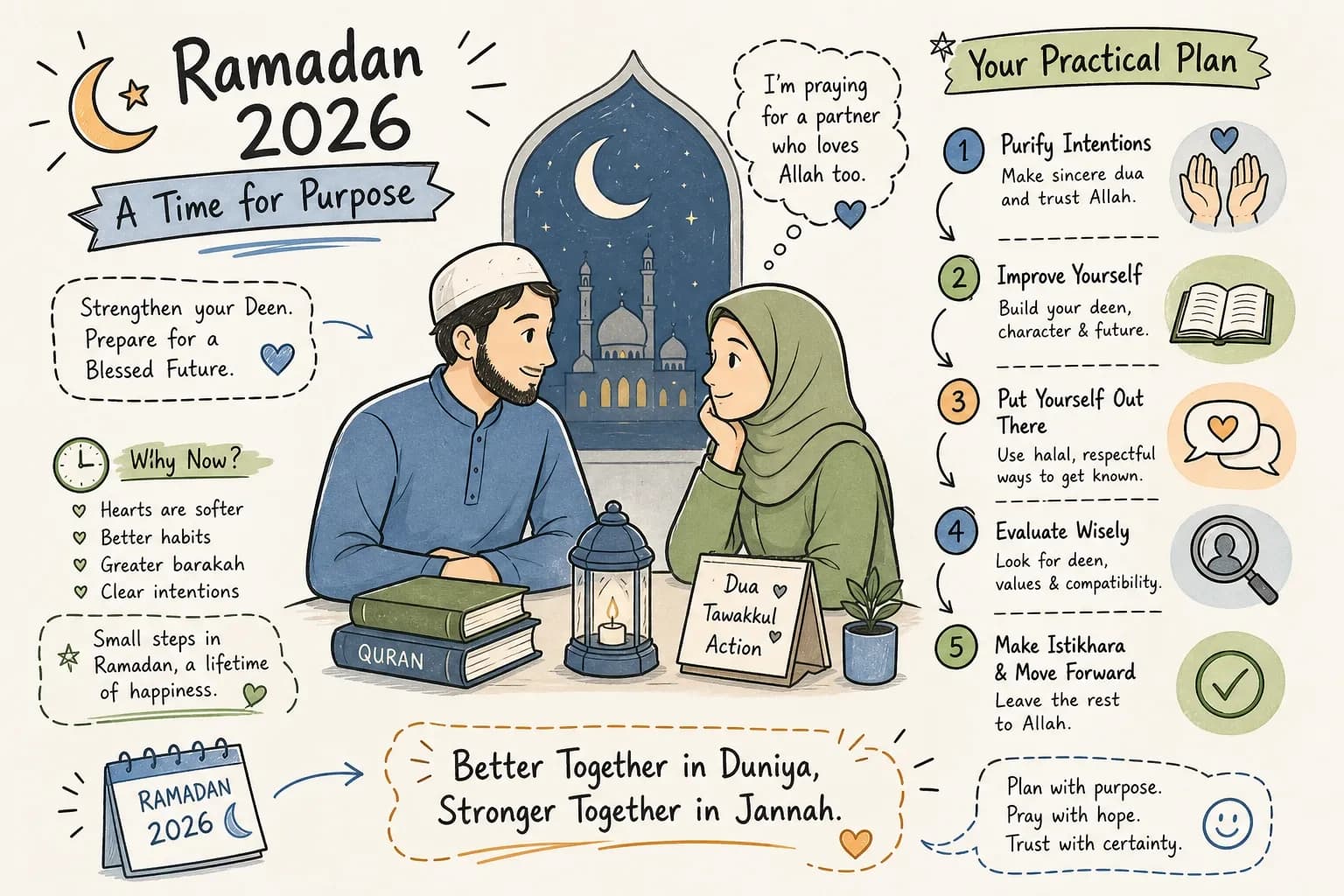
Ramadan 2026 begins around 19 February (Ramadan 1447 AH) and runs until approximately 20 March, that is 29 to 30 days of fasting, reflection, and recalibrated priorities, with the exact end date depending on local moon sighting. Many Muslims spend these days deepening their ibadah. But for those who are serious about nikah, this month does something quietly powerful: it strips away distraction and makes what matters most feel urgent and clear.
This article is not a spiritual essay. It is a practical plan for educated Muslim men, women, and families who want to use Ramadan 2026 as a meaningful window to begin or advance their nikah journey. Many matrimonial platforms built for nikah-minded Muslims see noticeably higher engagement during Ramadan, and Barkat, built specifically for educated, faith-driven Muslims, is no exception. Intention sharpens in this month. So do decisions.
Here is how to use every one of those days wisely.
Why Ramadan 2026 creates the right conditions for nikah
The spiritual clarity that comes with fasting
Fasting quietens the noise that normally delays major life decisions. During Ramadan 1447 AH, Muslims are already in a heightened state of accountability: reviewing their actions, examining their intentions, and asking honest questions about what they want from their lives. Marriage is exactly the kind of decision that benefits from this level of self-examination. When a person spends Ramadan genuinely asking "Am I ready for nikah?", they are far more prepared to act on the answer than someone asking the same question on an ordinary Tuesday.
This is not incidental, it is the design of the month. When worldly appetites are restrained and one's connection to Allah is stronger, life comes into sharper focus. For readers less familiar with Islamic practice: the discipline of fasting quietens the pull of impulse and habit, creating mental and spiritual space for decisions that require real honesty. That clarity is what makes Ramadan the most productive time to begin a nikah search.
Why families move faster in this month
Ramadan brings families together around shared rituals: suhoor, iftar, taraweeh. These gatherings naturally open conversations that might otherwise take months to schedule. For parents looking for a suitable match for their son or daughter, the social infrastructure of Ramadan is already in place. The family is already gathering. The conversations are already deeper. It is simply a matter of using that structure deliberately.
Families who have been putting off the nikah conversation often find that Ramadan is the moment they finally act. A simple acknowledgement over iftar, "We should start looking seriously", can open doors that months of indirect hinting could not. Use that momentum.
Etiquette educated Muslims should follow when seeking a spouse during Ramadan
What singles need to keep in mind
Clear, sincere niyyah is the foundation of every matrimonial conversation during Ramadan. Before reaching out to any potential match, be honest with yourself: are you genuinely ready for nikah, or are you still exploring? If you are ready, say so. Singles should avoid prolonged one-on-one messaging that lacks family oversight, and should approach each interaction with the seriousness the month demands. Ramadan is not the time for indefinite "getting to know you" phases that go nowhere.
A good first conversation should cover deen and values, family expectations, work or study situation, and non-negotiables. Keep it focused and purposeful. If there is mutual interest after two or three exchanges, involve your wali or family immediately, this is practical advice rather than a doctrinal rule, but it is one that most families and scholars of Islamic etiquette broadly endorse.
How families can initiate without overstepping
Families play a central role in nikah, and Ramadan is a natural moment to reach out to other families. Keep early conversations focused on compatibility: values, educational background, family expectations, and geography. Avoid putting undue pressure on candidates, and involve the interested party in decisions from the outset. Respect and clarity are not in conflict; they work together.
The most effective family introductions during Ramadan are brief, warm, and honest. A five-minute phone call between parents, followed by a structured meeting for the individuals involved, is often more productive than weeks of indirect signalling.
Where to meet serious, faith-driven Muslims during Ramadan 2026
Organised iftar circles and community events
Iftar gatherings hosted by mosques, university alumni networks, and community organisations are one of the most culturally natural settings for initial introductions during Ramadan 2026. Many cities across India run structured community iftars where families attend together. To find these events, check local masjid notice boards, WhatsApp community groups, and university alumni chapters from institutions like AMU, Jamia, and IIT. In cities such as Delhi, Mumbai, and Hyderabad, matrimonial iftar events hosted by Muslim community organisations are increasingly common, many involve pre-registration and a structured format designed to keep interactions purposeful and family-aware, though the exact model varies by city and organiser.
The key is to attend with intention. An iftar circle is not just a meal; it is an opportunity to observe how someone carries themselves during a month that reveals character.
Moderated online meet-ups and virtual iftars
For diaspora Muslims, those in smaller cities, or those who prefer structured introductions, virtual iftars and moderated matrimonial meet-ups offer a practical alternative. A moderated online meet-up typically involves a short, structured conversation with a third party present, whether a family member or a platform representative. Questions are focused on nikah readiness, and there are clear next steps at the end. Virtual does not mean casual. The format simply removes geography as a barrier while keeping the process deliberate and overseen.
Ramadan timetable 2026 India: suhoor and iftar times by phase
Knowing the Ramadan calendar India 2026 is essential for planning your nikah journey around the month's rhythm. The Ramadan start date 2026 is projected as 19 February, subject to moon sighting confirmation in India. Suhoor and iftar times vary by city, for example, in Delhi, suhoor during the first week of Ramadan 2026 is expected around 5:15 AM IST and iftar around 6:30 PM IST, while Hyderabad and Mumbai times will differ by 15 to 30 minutes. Consult your local masjid or a verified Ramadan timetable 2026 India source for city-specific iftar and suhoor times 2026. The crescent moon was widely expected to be visible in India on the evening of 18 February 2026, making 19 February the first day of fasting if confirmed by the relevant sighting committee.
On the question of moon sighting Ramadan 2026: India follows local hilal sighting, so the Eid al-Fitr 2026 date, expected around 20 March, may shift by a day depending on announcements from regional moon-sighting authorities. Plan around this flexibility rather than treating any date as fixed.
Using dua and reflection to gain clarity about your future spouse
Specific duas for seeking a righteous spouse
The dua from Surah Al-Furqan (25:74) is one of the most widely recommended for this purpose: "Rabbana hab lana min azwajina wa dhurriyatina qurrata a'yunin waj'alna lil-muttaqina imama", "Our Lord, grant us from among our spouses and offspring comfort to our eyes, and make us leaders for the righteous." Another dua frequently cited is from Prophet Musa (AS) in Surah Al-Qasas (28:24): "Rabbi inni lima anzalta ilayya min khayrin faqir", "My Lord, I am truly in need of whatever good You may send down to me." Both are appropriate to recite when sincerely seeking a righteous spouse.
Embed these duas into your suhoor or post-taraweeh time, when your focus is sharpest. Recite them after each salah, in sujood, and at the moment of breaking your fast. Clarity of intention in dua often corresponds to clarity in decision-making. The two are not separate processes.
Using Laylatul Qadr to commit to a next step
The last 10 nights of Ramadan 2026, running approximately from 11 to 20 March (subject to moon sighting), carry immense spiritual weight. Islamic tradition does not treat Laylatul Qadr as a night to wait passively for a sign; rather, it is the best opportunity to make dua with specificity, perform istikhara, and ask Allah to decree what is best for your faith and your life. For nikah, this is a deeply practical approach: bring your situation before Allah with honesty, ask for the path to be opened if the match is good, and ask for it to be turned away if it is not.
Use these nights to make a firm internal commitment. Have you identified someone you want to pursue? Have you spoken to your family? Have you updated your profile on a serious platform? Laylatul Qadr is about seeking, not simply waiting. The action and the dua work together.
How Barkat helps educated Muslims find their match this Ramadan
Built for people who take education and deen seriously
Barkat is designed for Muslim graduates and professionals from institutions like AMU, IIT, Jamia, and beyond. According to the platform, every profile is manually reviewed before going live, meaning you are not sifting through casual or unverified accounts. The Alma Mater filter, a feature the platform highlights, lets you search for matches who share not just faith but campus culture and educational background, a combination that matters to educated Muslim families who understand the role of shared context in a lasting marriage.
Barkat says it was built by AMU alumni, from within the community it serves, and that origin shapes how the platform approaches matchmaking. It understands what educated Muslim families are actually looking for because its founders lived that experience themselves.
Personalised support when you need it most
The dedicated Barkat team supports users throughout the matchmaking process, which is especially valuable during Ramadan when conversations are time-sensitive and families want guidance on next steps. This is not an algorithm running unsupervised. The team can help you review match suggestions, advise on communication etiquette, and assist families in structuring introductions respectfully. If you are serious about using Ramadan 2026 as your nikah window, having a knowledgeable support team alongside you makes that effort more focused and more fruitful.
A phase-by-phase action plan for Ramadan 2026
Whether Ramadan runs 29 or 30 days this year, breaking it into three phases makes the journey manageable and purposeful. The dates below assume a 30-day Ramadan starting 19 February; if the month is 29 days, each phase end date shifts back by one day accordingly.
First 10 days (19 February to 28 February): reflect and prepare
Use this phase to clarify your nikah criteria with honesty: values, educational alignment, family expectations, geography, and non-negotiables. Complete or update your matrimonial profile on Barkat. Share your intention clearly with your wali or family so they know you are actively searching. This is the foundation phase, get honest about what you want before you start looking, because clarity at this stage saves you weeks of misaligned conversations later.
Middle 10 days (1 March to 10 March): initiate and engage
Rather than launching straight into a list of instructions, consider this phase for what it actually is: a window of momentum. Ramadan's middle days carry the fatigue of the first week but not yet the intensity of the final nights, which makes them ideal for measured, purposeful action. Begin structured conversations with shortlisted profiles. Attend iftar circles or moderated meet-ups. Involve your family early and avoid prolonged solo exchanges. After two or three conversations, you should have a reasonable sense of compatibility. If there is no alignment, acknowledge it respectfully and move on, Ramadan's middle phase is for genuine engagement, not indefinite browsing.
Last 10 days (11 March to 20 March): make dua and commit to next steps
The last 10 nights are for ibadah and decision-making together. If you have identified a promising match, use this phase to perform istikhara and speak to your family about moving forward formally. If you have not yet found a match, commit to staying active on Barkat beyond Ramadan. Eid al-Fitr 2026, expected around 20 March (subject to moon sighting), is a milestone, not a deadline. The work of finding a spouse is ongoing, and Ramadan gives it the best possible start.
The days that can change everything
Ramadan 2026 is not just a month of fasting. It is an extraordinary window of spiritual focus that, when used with intention, can accelerate one of the most important decisions of your life. The conditions are already in your favour: your deen is sharpest, your family is close, and your priorities are clear.
Right now, you can clarify your intention and write it down. You can identify one concrete avenue to meet potential matches, an iftar circle, a virtual meet-up, or a platform like Barkat. And you can make dua with specificity and consistency every day of this month. None of these steps is complicated. All of them compound.
Nikah is half of deen. Ramadan is when your deen is at its clearest. The two were always meant to overlap. If you are an educated Muslim ready to take this seriously, Barkat is where your search begins.