Islamic Quotes for Nikah Invitations, Profile Bios and First Conversations
Islamic quotes for nikah invitations, bios, and first messages: sourced Quran verses, sahih hadiths, bio examples, and citation tips.
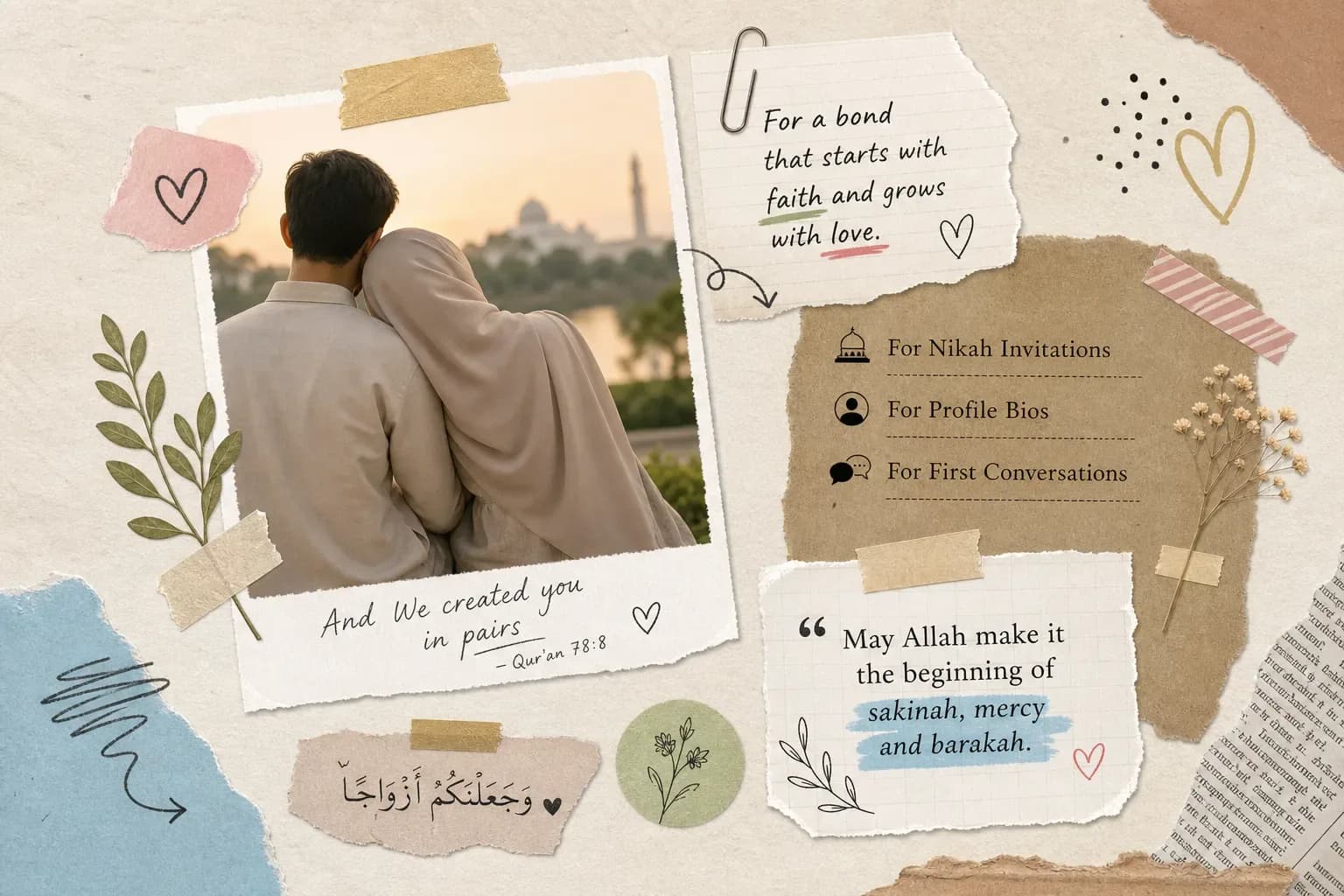
There is a particular kind of anxiety that arrives when you are staring at a blank nikah invitation or the "About Me" box on a matrimony profile. You want the words to mean something, and that search for the right Islamic quotes is where most people get stuck. Not the recycled WhatsApp forward about roses and sunsets. Not the vague line about "seeking a partner who fears Allah" that appears on a thousand other bios. Something true and sourced, something that actually reflects who you are and what this moment means to you.
The trouble is that many Islamic quotes in circulation online are misattributed, missing their source entirely, or so generic that they say nothing specific about the person sharing them. A verse floating above someone's profile photo without a surah reference can be a missed opportunity. A hadith cited as "Prophet Muhammad ﷺ said" with no further detail is the kind of thing that makes a discerning family quietly nervous.
This article is a curated, sourced, usable collection of Quranic verses, hadith excerpts, and faith-centred lines, organised by occasion, with context and practical bio examples written for Muslim graduates and professionals. On platforms that manually review every profile before it goes live, the words in your bio carry real weight. This article will help you get them right.
For more general reminders, see Islamic quotes about life and Islamic quotes for life.
Quranic verses & Islamic quotes for nikah invitations
A nikah invitation is not decoration. It is a declaration of intention, and the Quranic verse at the top of that card sets the tone for everything that follows. These particular verses have appeared on Muslim wedding invitations for generations because they speak directly to the covenant of marriage, not to faith in general. That specificity matters.
A verse that nikah invitations commonly reach for first
Quran 30:21 is the verse families return to again and again, and for good reason. The full Arabic reads: وَمِنْ آيَاتِهِ أَنْ خَلَقَ لَكُم مِّنْ أَنفُسِكُمْ أَزْوَاجًا لِّتَسْكُنُوا إِلَيْهَا وَجَعَلَ بَيْنَكُم مَّوَدَّةً وَرَحْمَةً. The translation: "And of His signs is that He created for you from yourselves mates that you may find tranquillity in them; and He placed between you affection and mercy." This verse is specifically about marriage, not a general statement about love, which is precisely why it earns its place on an invitation rather than a card for any other occasion. When you cite it as Surah Ar-Rum, 30:21, you are doing something considerate for the reader: you are telling them exactly where to find it and confirming that you did not simply copy it from a design template.
Verses about trust and Allah's plan for the bio or card
Three shorter verses work beautifully as secondary quotes on an invitation or as standalone lines in a profile bio. From Surah At-Talaq (65:3): وَمَن يَتَوَكَّلْ عَلَى اللَّهِ فَهُوَ حَسْبُهُ, "Whoever relies upon Allah, then He is sufficient for him." This is a quiet, confident expression of tawakkul that works especially well for anyone navigating a long or uncertain search. From Surah Al-Baqarah (2:286): لَا يُكَلِّفُ اللَّهُ نَفْسًا إِلَّا وُسْعَهَا, "Allah does not burden a soul beyond that it can bear." And from 2:201, the beloved dua: رَبَّنَا آتِنَا فِي الدُّنْيَا حَسَنَةً, "Our Lord, give us good in this world and good in the Hereafter." Each of these is short enough to print cleanly and specific enough to carry genuine meaning.
How to format a Quranic quote on a printed invitation
The format that works best, and reads most respectfully, is Arabic first, then the English translation beneath it, then the reference in parentheses: (Quran 30:21) or (Surah Ar-Rum, verse 21). Never paraphrase a Quranic verse and present it as a direct quote. A paraphrase is fine as commentary, but if you place it inside quotation marks and attribute it to Allah's word, you are no longer quoting Allah's word. This is about accuracy and respect for the text, not just aesthetics.
Hadith quotes that work in a first message or bio
A hadith quote in your opening message or profile bio signals something deliberate: that you engage with the Sunnah thoughtfully and have considered which part of it you want to lead with. It only works, though, if the hadith is correctly cited and actually authentic. This is where many well-intentioned bios quietly fall apart.
Three Sahih hadiths that educated Muslims return to
The most foundational is also the briefest: إِنَّمَا الأَعْمَالُ بِالنِّيَّاتِ, "Actions are only by intentions" (Sahih al-Bukhari and Sahih Muslim, reported from Umar ibn al-Khattab). It is the perfect bio opener for someone who wants to signal sincerity without overstating it, short, graded sahih, and doing the work of an entire paragraph in five Arabic words.
The second lands particularly well in a first message: إِنَّ اللَّهَ لَا يَنْظُرُ إِلَىٰ صُوَرِكُمْ وَلَا إِلَىٰ أَمْوَالِكُمْ وَلَكِنْ يَنْظُرُ إِلَىٰ قُلُوبِكُمْ وَأَعْمَالِكُمْ, "Allah does not look at your forms or wealth, but at your hearts and deeds" (Sahih Muslim). When you are opening a conversation on a matrimony platform and want to signal that you are not leading with credentials or family status, this is the line that says it without requiring you to explain yourself. The work is already done.
The third speaks directly to graduates and professionals. Rather than leading with the Arabic, consider the context first: if you have spent years in pursuit of knowledge, at AMU, AIIMS, or IIT, the hadith that connects that journey to faith is مَنْ سَلَكَ طَرِيقًا يَلْتَمِسُ فِيهِ عِلْمًا سَهَّلَ اللَّهُ لَهُ بِهِ طَرِيقًا إِلَى الْجَنَّةِ, "Whoever follows a path seeking knowledge, Allah will make easy for him a path to Paradise" (Sahih Muslim). It does the work of a personal statement with both precision and beauty.
The ones to leave out: weak and unverified quotes that circulate widely
Some of the most-shared "Islamic quotes" on Instagram and WhatsApp are either misattributed to the Prophet ﷺ or graded as da'if (weak). "Seek knowledge even if you have to go to China" is a popular example: it circulates as a hadith but is widely identified by scholars as an Arabic proverb with no reliable chain. "Love of one's homeland is part of faith" and "Differences in my Ummah are a mercy" are also repeatedly flagged as fabricated narrations. Before you put any hadith in your bio or opening message, verify it. Sunnah.com is a practical checking tool that lets you search by keyword and see the grading. Taking five minutes to verify protects you and the integrity of what you are sharing.
Themed Islamic quotes for social sharing and profile status
Not every quote needs to go on an invitation or a matrimony bio. Some are for your Instagram caption at Fajr, your WhatsApp status during a difficult week, or the inspirational Islamic quote you return to when you need grounding. Here is a themed reference that works across those contexts, with sources you can actually cite.
Patience and tawakkul: for the waiting
Two verses carry this theme particularly well. From Surah Al-Baqarah (2:153): "Indeed, Allah is with the patient." It is short and unambiguous, precisely its strength as an Islamic reminder you can share without elaboration. From Surah Al-Hadid (57:4): "And He is with you wherever you are." This second verse is especially meaningful for diaspora Muslims navigating a marriage search across time zones and continents. The source reference matters when you share either of these: a verse citation tells your reader that this is not an inspiration account's original copy, but Allah's word, and that difference changes how the post is received and saved.
Gratitude and contentment: for the good days
From Surah Ibrahim (14:7): "If you are grateful, I will surely increase you." From Surah Ar-Ra'd (13:28): أَلَا بِذِكْرِ اللَّهِ تَطْمَئِنُّ الْقُلُوبُ, "Truly, in the remembrance of Allah do hearts find rest." These two Quranic quotes circulate widely as Islamic quote images in India, and it is easy to see why: they are short enough for a story card and true enough to sit with for days. When you add the surah and verse number to your post, you make it more trustworthy, more citeable, and far more likely to be reshared by someone who values accuracy.
Using Islamic quotes in your profile bio: examples for graduates and professionals
The most effective matrimony profile bios do not treat the Islamic quote as a filler line at the top. They use it to signal character, and then the qualifications, values, and personality follow naturally from it. The quote becomes a frame rather than a decoration. On Barkat, where every profile is manually reviewed before it appears on the platform, the profiles that read most authentically are the ones where the quote and the person match. You can tell that the person actually thought about why that particular verse or hadith belongs in their introduction, and that deliberateness comes through.
If you also need a structured biodata layout, use the Muslim matrimony biodata template.
What a strong bio opening looks like
Here are three illustrative examples in the style of educated Muslim professionals:
- AMU Medical postgraduate: "إِنَّمَا الأَعْمَالُ بِالنِّيَّاتِ, I lead with intention, in work and in marriage. MBBS and MD from AMU. Looking for a partner who values deen, curiosity, and a kitchen that smells of good food and good conversation."
- IIT graduate: Opens with the knowledge-seeking hadith from Sahih Muslim, followed by: "Spent five years at IIT building things. Now looking for someone to build something more lasting with. Serious about faith, serious about this."
- Jamia alumna: Uses 30:21 not as the header but as the closing line of her bio, which creates a framing effect, the verse becomes a conclusion rather than a decoration, and it lands with considerably more weight.
Alma Mater-themed quote pairings
Certain Islamic sayings align naturally with the culture of specific institutions and the identities that grow from them. The AMU graduate who pairs the knowledge-seeking hadith with a mention of their campus is making a connection between faith and academic tradition that feels earned rather than generic. The diaspora Muslim professional who uses 65:3 ("Whoever relies upon Allah, He is sufficient") to frame a long-distance search is expressing tawakkul in a way that is specific to their situation. On Barkat's Alma Mater filter, these pairings can feel intentional rather than random, because, when chosen thoughtfully, they are.
Citing, attributing and sharing Islamic quotes: what to get right
Sharing an Islamic quote without a source is like passing on advice without saying who gave it. In an age of viral WhatsApp forwards, accuracy is an act of care for the community. The quote you post today will be screenshotted, reshared, and appear in someone else's bio by tomorrow morning. Getting the citation right the first time matters.
Quran vs Hadith vs scholar quote: why the label matters
There is a clear hierarchy, and mislabelling any level of it is a common and avoidable mistake. A Quranic verse is the word of Allah. A hadith graded sahih is an authenticated narration of the Prophet ﷺ. A hadith graded hasan (good) carries weight but slightly less certainty. A quote attributed to a scholar, however wise, is the opinion of a human being. When you label all four of these as simply "Islamic quotes," you flatten distinctions that matter to your reader and to the tradition itself. Label them clearly: "Quran 13:28," "Sahih Muslim," "attributed to Imam Al-Ghazali." That one small habit makes everything you share more honest and more useful.
Copyright and attribution for quote images in India
The Quranic verse text and hadith text are not copyrightable. However, a modern translation, a designed quote card, or a curated compilation can carry intellectual property rights. The clearest approach: write your own clean translation, or use a clearly public-domain version. Include the source reference, surah and verse number, or hadith collection, clearly in small text on the image. Do not copy a pre-designed card from another page without permission, even if the verse itself is public domain. The design, typography, and translation expression may be someone else's original work.
Quick tips for a shareable Islamic quote image
The quote cards that get saved and reshared rather than scrolled past share a few consistent qualities: a plain or soft pastel background, brief text, Arabic with the English translation beneath it, and the surah or hadith reference in small type at the bottom. For nikah or matrimony-related posts, a gold or cream palette with clean typography consistently outperforms busy designs. These recommendations reflect observed trends in what travels well on Indian Instagram and WhatsApp, and they align with the minimalist, text-forward aesthetic that makes Islamic status quotes genuinely shareable rather than merely pretty.
The right words for the right moment
You are not looking for a quote to fill space. You are looking for the right words for one of the most significant conversations of your life, whether that is an invitation going out to family, a bio that a stranger will read in two seconds, or an opening message that needs to feel sincere rather than scripted. The stakes are not small, and they deserve the care you are giving them.
The best Islamic quotes are accurate, properly sourced, and genuinely personal to the person sharing them. A verse that means something to you, cited correctly, says more about your character than ten borrowed lines strung together. It tells the reader that you thought about it. And in a matrimony context, that is exactly the kind of signal that opens a real conversation.
If you are ready to put your best words forward on a platform built for educated Muslims, one that manually reviews every profile, connects you through university, values and intention, and takes the process as seriously as you do, Barkat is where these lines find their audience. Create your profile and put these quotes to use where they were always meant to go.